Vibrator Selection Basics
In Japan, the standards for concrete vibrators are defined by JIS A 8610 (Internal Concrete Vibrators) and JIS A 8611 (External Concrete Vibrators).
Under JIS A 8610, internal vibrators with a head diameter of less than 90 mm must operate at 130 Hz or higher, while those with a diameter of 90 mm or greater must operate at 90 Hz or higher. Under JIS A 8611, external vibrators are classified as low-frequency at 20–69 Hz and high-frequency at 71 Hz or higher.
However, our products deliver a performance that far exceeds these minimum requirements.
This article explains the background and reasons why high-frequency vibrators have become the industry standard for modern concrete compaction.

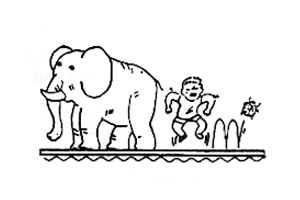
The illustrations above demonstrate how vibration affects objects differently depending on their mass. An elephant, a boy, and a ladybug, each having a different weight, are standing on the same plate.
In Figure (A), which illustrates the effects of low-frequency vibration, the heavy elephant is greatly affected, while the lighter boy and ladybug experience relatively little movement.
In contrast, Figure (B) shows the effects of high-frequency vibration. The elephant is scarcely affected, whereas the boy experiences significant vibration and the ladybug is affected even more dramatically.
As described above, the effect of vibration is related to the mass of the object being vibrated, and higher-frequency vibration is more effective for lighter particles.
This principle also applies to fresh concrete.
Low-frequency vibration of approximately 25 Hz (1,500 vpm) is effective for moving large coarse aggregates, while frequencies of 50 to 100 Hz (3,000 to 6,000 vpm) are suitable for smaller coarse aggregates. For fine aggregates and the cement paste matrix, high-frequency vibration in the range of 150 to 240 Hz (9,000 to 14,000 vpm) is particularly effective.
In the past, these vibration frequencies were achieved by increasing the rotational speed of a small gasoline engine using a V-belt drive, as in the E-MF Series.
Since high-frequency vibrators have become the industry standard, these units use an inverter to convert the commercial power supply frequency (50 or 60 Hz) to drive an internal pendulum with a specially designed motor built into the vibrator head.
In addition, the voltage between the inverter/converter and the vibrator is reduced to 48 V, improving operational safety in accordance with the following regulations:
- Ministry of Health, Labour and Welfare, Industrial Safety and Health Regulations
Article 333: Prevention of Electric Shock Caused by Leakage Current
Article 334: Exemptions - Ministry of Economy, Trade and Industry, Electrical Appliance and Material Safety Act
Appendix 8 (General Structural Requirements) - Ministry of Economy, Trade and Industry, Technical Standards for Electrical Facilities
Chapter 4, Article 28: Grounding of Metal Frames and Enclosures
Chapter 4, Article 42: Ground-Fault Protection Devices
As a result, modern high-frequency vibrators provide a high level of safety while also being lighter than conventional equipment.
Furthermore, EXEN's patented HBM Fin Head features a unique vibrating head design that reduces vibration transmission losses, helping to produce high-quality concrete structures.