Types of Vibrators
This section provides an overview of the various types of concrete vibrators. A wide range of vibrator types is available to accommodate different structural applications, formwork conditions at the job site, and product requirements.
These vibration systems can be classified into the following categories:
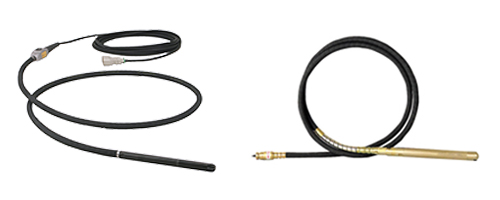
Internal Vibrators
Internal vibrators are inserted directly into the concrete, where they transmit vibration to achieve compaction.
Although various shapes and sizes are available, cylindrical poker-type vibrators are the most commonly used.
Most internal vibrators utilize either:
・A high-frequency system with a rotating eccentric weight housed inside the vibrator head (such as the HBM Series and portable vibrator series), or
・The HV system, in which the rotating shaft performs planetary motion and generates impact vibration.
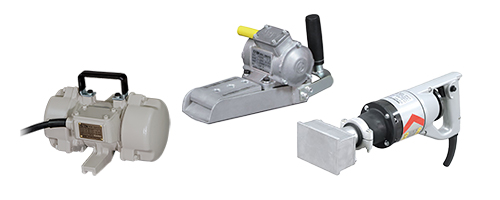
External Vibrators (Portable Type)
These vibrators compact concrete by being mounted to the outside of the formwork or by being applied directly to the formwork surface.
Typical types include:
・Mounted vibration motors such as the KM and EVSI Series
・Simple attachment types for building formwork, such as the Woodpecker and Iron types
・Handheld models such as the EKCA, EKDA, and CBKCB Series
These vibrators are commonly used in precast concrete plants, in locations where internal vibrators cannot be used, and for concrete wall finishing applications.
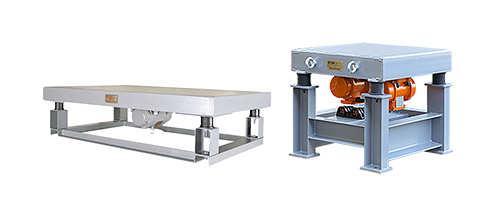
External Vibrators (Fixed Type)
In this method, the formwork is placed on a vibrating table, and the entire form is vibrated to consolidate the concrete.
It is primarily used in factories for manufacturing precast concrete products.
For small- to medium-sized products, electric vibrators are commonly used. These include low-frequency models designed for both concrete placement and consolidation, as well as high-frequency models intended primarily to improve surface finish quality.
For applications involving payloads exceeding approximately 5 to 7 tonnes, or where noise reduction during concrete placement is required, hydraulic clamp-type systems are often the preferred solution.