Calculation of Centrifugal Force and Amplitude
Centrifugal Force Generated by Vibration Motors
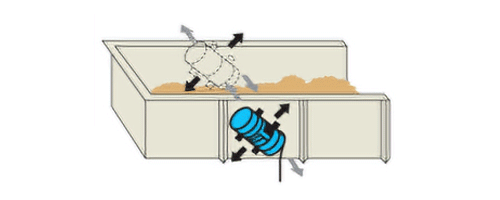
As illustrated in Figure X, a vibration motor generates centrifugal force in all directions on the vibrating body through the rotation of an unbalanced weight.

This centrifugal force F is expressed by the following equation:
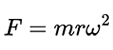
When the angular velocity ω is expressed in terms of vibration frequency f, the force can be calculated using the following formula:


| Symbol | Meaning | Unit |
|---|---|---|
| F | Centrifugal force | N |
| m | Unbalanced mass | kg |
| r | Eccentric distance | m |
| f | Vibration frequency | Hz |
Controlling Vibration Direction with Two Motors (Principle of Linear Motion)
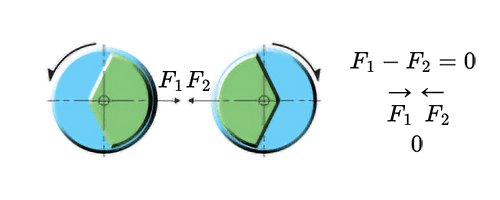
A well-known method is to install two vibration motors on the same rigid structure and operate them in
opposite rotational directions using the same electrical circuit. Under the condition that the centrifugal
forces generated by the two motors are equal (
 ), the following phenomena occur.
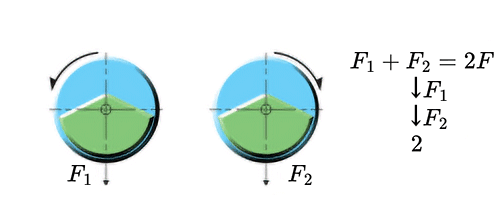
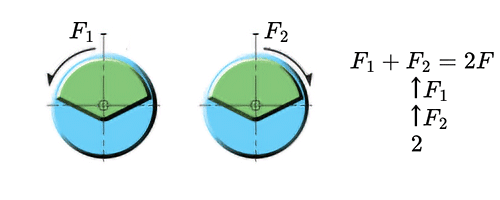
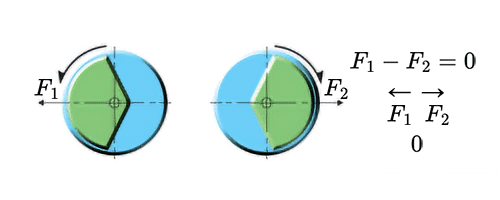
- In Figures Y-1 and Y-3, the vertical components of F1 and F2 act in phase, resulting in a combined force that is twice as large.
- In Figures Y-2 and Y-4, the horizontal components cancel each other, resulting in zero horizontal force.
The motion paths shown in Figures Y-1 through Y-4 produce linear vibration similar to that of a vertical piston mechanism.
An example applying this principle is the table vibrator shown in Figure Y-5.
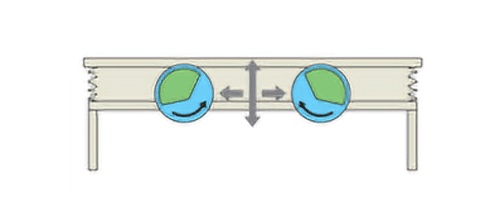
By tilting the direction of the generated force, materials can be propelled horizontally while being lifted and advanced in small increments, enabling conveyor operation through vibration.
Calculation of Total Amplitude
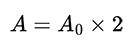
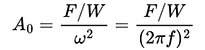
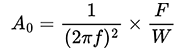
For the single amplitude A0 generated by the resultant vertical centrifugal force (measured as the displacement from the motor center to one side), the total amplitude A is given by the following relationship:
First, the general equation used to determine the single-sided amplitude A0 is shown below.
The following transformed equation provides a simplified method for calculating amplitude using the vibration frequency f.
| Symbol | Meaning | Unit |
|---|---|---|
| A | Total amplitude (peak-to-peak amplitude) | m |
| F | Centrifugal force (combined centrifugal force) | N |
| W | Vibrating mass | kg |
| f | Vibration frequency | Hz |