Why Does Concrete Consolidate Under Vibration?
Let's take a closer look at the principles of vibration and consolidation, an essential process in concrete placement. When vibration is applied to a fresh concrete mixture, the movement of the aggregates is proportional to the vibration acceleration and inversely proportional to their mass. In other words, large aggregates move less, while smaller aggregates move more easily.
The horizontal vibration generated by an internal vibrator temporarily fluidizes fresh concrete, allowing it to consolidate under the force of gravity.
The concrete closest to the source of vibration becomes denser first, and vibration is then transmitted through this consolidated zone to the surrounding areas of the concrete mass. However, because vibration amplitude is gradually absorbed by the material, the effective range of vibration is limited.
This limitation varies depending on the characteristics of the concrete and the vibrator. In general, however, the following factors have a significant benefit:
- A vibrator equipped with an exciter capable of generating higher vibration acceleration.
- A vibrator with a head design optimized for efficient vibration transmission (e.g., EXEN HBM-VF/ZX Series).
- Appropriate vibration duration.
Important Considerations
Textbooks often warn that excessive vibration compaction may cause aggregate segregation. However, based on our experience, aggregate segregation is generally observed only in controlled experiments or precast concrete manufacturing plants. On typical construction sites, cases of truly excessive vibration are extremely rare.
In fact, many concrete placement defects encountered in the field are more often attributable to insufficient vibration rather than excessive vibration.
Rule of Thumb
The following guidelines are widely used in the field:
- Use a vibrator with a diameter approximately equal to the maximum aggregate size.
- The effective compaction range should not exceed ten times the vibrator diameter (for example, a 50 mm vibrator should be repositioned within 500 mm intervals).
- Apply vibration for at least 18 seconds at each insertion point.
Example of a Concrete Placement Test and Its Results
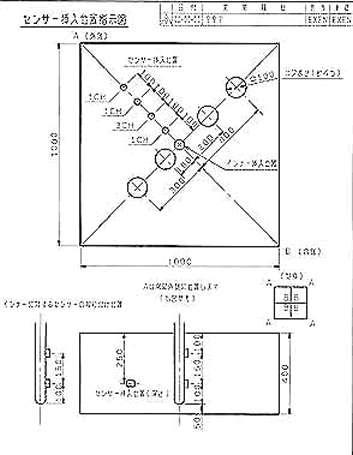
1. Vibrator and Sensor Placement Plan
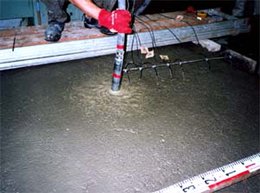
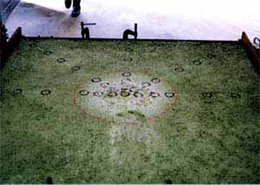
2. Consolidation Operation and Verification of Vibration Transmission Range
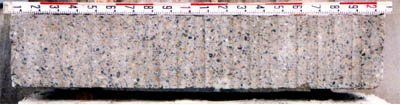
3. Examination of Internal Conditions