Using the Three-Axis Composite Value for Worker Safety Management
This page explains the concept of Three-Axis Composite Value used for concrete vibrators and outlines the practical methods for managing vibration exposure in the workplace.
On July 10, 2009, Japan's Ministry of Health, Labour and Welfare issued the “Guidelines for the Prevention of Vibration Disorders Associated with the Use of Vibrating Tools” (Notification No. 0710001). These Guidelines clarified the procedures for measuring, evaluating, and managing vibration exposure in order to prevent vibration-related health disorders.
The fundamental value used in these guidelines is the Three-Axis Composite Value.
Its formal name is the Frequency-Weighted Root-Mean-Square Acceleration, Three-Axis Composite Value.
A key feature of the guidelines is that evaluation is based not on vibration measured along a single axis, but on the combined vibration level from all three axes.
The following sections explain the measurement, evaluation, and management methods applicable to concrete vibrators.
What Is Three-Axis Composite Value?
The Three-Axis Composite Value is the fundamental measurement used to quantitatively evaluate the amount of vibration transmitted to the hand and arm.
The vibration is measured in three orthogonal directions (the X, Y, and Z axes). Frequency weighting factors representing the transmission characteristics of hand-arm vibration are applied to each axis, and the resulting RMS values are combined to obtain the Three-Axis Composite Value.
This value is measured using an instrument compliant with JIS B 7761-1 and in accordance with the measurement procedures specified in JIS B 7761-2.
The greater the value, the higher the level of vibration transmitted to the hand and arm.
The Three-Axis Composite Value is calculated by combining the values measured along the three axes using the following equation:
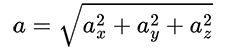
ax, ay, az:Frequency-Weighted RMS Acceleration Values for the X, Y, and Z Axes, respectively(m/s2)
Note 1:
In JIS standards and the Ministry of Health, Labour and Welfare notification, the symbol ahv is used
to denote hand-arm vibration. In this article, the same value is referred to as the Three-Axis Composite
Value.
How Is the Three-Axis Composite Value Used?
- Determine the maximum daily operating time of the vibrator (vibration exposure limit) based on the Three-Axis Composite Value.
- Develop a work plan based on the calculated allowable operating time (vibration exposure limit).
- Provide the work plan to operators and ensure that work is performed in accordance with the plan.
By following these procedures, employers (contractors and site supervisors) successfully manage workers' vibration exposure times and promote the prevention of vibration-related disorders.
Determining Allowable Operating Time Using the Three-Axis Composite Value
The standard procedure requires calculating the Daily Vibration Exposure A(8).
However, the Guidelines for the Prevention of Vibration Disorders (Notification No. 0710002, hereinafter referred to as "Notification 0710-2") provide a direct relationship between the Three-Axis Composite Value and the allowable operating time (vibration exposure limit time), making calculation simpler.
Even if the calculated allowable operating time exceeds two hours, daily vibration exposure is generally limited to two hours or less, except under special circumstances specified in Notification 0710-2, Section 3(3)(c).
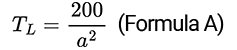
What Is Daily Vibration Exposure A(8)?
Daily Vibration Exposure A(8) represents the total vibration exposure to the hand and arm during an eight-hour working day.
Since different vibration tools are used for different lengths of time, the impact of vibration exposure cannot always be evaluated solely from the Three-Axis Composite Value.
When actual daily operating time is known, calculating and managing A(8) provides a more effective means of evaluating exposure.
Managing Vibration Exposure Using A(8)
Calculation of A(8)

T:Daily vibration exposure duration (hours)
Evaluation of A(8)
Detailed requirements are specified in Notification 0710-2, Section 3(2).
The Exposure Action Value is 2.5 m/s², while the Exposure Limit Value is 5.0 m/s².
The general framework for vibration exposure control is outlined below.
| A(8) Value | Required Action |
|---|---|
| A(8) ≤ 2.5 m/s2 | No special measures are required; however, use should generally be limited to two hours or less per day, except under special circumstances. |
| 5 .0m/s2 ≧ A(8) > 2.5 m/s2 | Make efforts to reduce operating time and select lower-vibration tools. |
| A(8) >5.0 m/s2 | Implement appropriate measures to ensure exposure does not exceed 5.0 m/s2. |
When the A(8) value exceeds 5.0 m/s2, possible corrective actions include:
- Revising work schedules to reduce vibration exposure time.
- Rotating work among multiple operators.
As a result, it is expected that more employers will select equipment with lower Three-Axis Composite Values in the future. Manufacturers must therefore continue to develop products with reduced vibration levels.
Practical Examples of Evaluation
The following examples illustrate practical evaluation methods.
How Long Can the HBM40AXS Be Used?
Check the Three-Axis Composite Value of the HBM40AXS in Appendix 1.
-
Confirm the Three-Axis Composite Value (a)
3.4m/s2 -
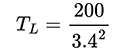
Calculate the Vibration Exposure Limit Time (TL)
Calculate TL using the prescribed formula.
-
Determine the Maximum Operating Time
The calculated TL is 17.3 hours, which exceeds two hours. According to Notification 0710-2, Section 3(2)(c), the daily operating time is therefore limited to two hours or less, except under special circumstances.
Is Four Hours of Daily Use with the E38FP Acceptable?
Notification 0710-2 limits vibration exposure to two hours per operator per day, except in special cases. Therefore, a four-hour work schedule for a single operator is not permitted. The evaluation should instead consider whether assigning additional workers is appropriate.
-
Confirm the Three-Axis Composite Value (a)
9.0m/s2 -
Calculate A(8) for the Initial Plan (One Worker for Four Hours)
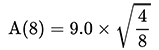
A(8) = 6.36 m/s² Since this exceeds the daily vibration exposure limit of 5.0 m/s², corrective measures are required. -
Recalculate A(8) After Countermeasures
Assume two workers each operate the tool for 2 hours (T = 2 hours).。
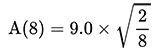
A(8) = 4.50 m/s² Since this is below the daily vibration exposure limit, the revised work plan of two workers × two hours each is adopted.
Responsibility for Management Values
Although ministry notifications do not explicitly define responsibility for managing the Three-Axis Composite Value and A(8), practical responsibility is generally divided as follows:
- Measurement and labeling of Three-Axis Composite Values: Equipment manufacturer
- Calculation, evaluation, and management of A(8): Employer (site supervisor or contractor)
Display of the Three-Axis Composite Value
The Guidelines for the Prevention of Vibration Disorders (Notification No. 0710003, hereinafter referred to as "Notification 0710-3") specify required display information.
Currently, explanatory documentation is provided individually upon customer request.
Information regarding the Three-Axis Composite Value, together with related materials referenced in this document, is also available on Exen's corporate website.
Furthermore, the required labeling has already been incorporated into both the product body and the instruction manual. Please refer to them for additional information.
Related Documents
End of document.